FunctionGemma is a specialized AI model for function calling. This post explains why fine-tuning is key to resolving tool selection ambiguity (e.g., internal vs. Google search) and achieving ultra-specialization, transforming it into a strict, enterprise-compliant agent. A case study demonstrates the improved logic. It also introduces the „FunctionGemma Tuning Lab,” a no-code demo on Hugging Face Spaces, which streamlines the entire fine-tuning process for developers.

The Universal Commerce Protocol (UCP) is a new, open-source standard for agentic commerce, co-developed by Google and industry leaders. It establishes a common, secure language to connect consumer surfaces (like Gemini and AI Mode in Search) with business backends, enabling seamless shopping from product discovery to purchase. UCP simplifies integration for businesses, supports various payment providers, and is designed to power the next generation of conversational commerce experiences.
A practical guide to debugging and profiling JAX on Cloud TPUs. It outlines core components (libtpu, JAX/jaxlib) and essential techniques. Tools covered include: Verbose Logging (via libtpu env vars), TPU Monitoring Library for performance metrics, tpu-info for real-time utilization, XLA HLO Dumps for compiler debugging, and the XProf suite for in-depth performance analysis.
Gemini 3 is powering the next generation of reliable, production-ready AI agents. This post highlights 6 open-source framework collaborations (ADK, Agno, Browser Use, Eigent, Letta, mem0), demonstrating practical agentic workflows for tasks like deep search, multi-agent systems, browser and enterprise automation, and stateful agents with advanced memory. Clone the examples and start building today.
Conductor is a new Gemini CLI extension that promotes context-driven development. It shifts project context from chat logs to persistent Markdown files for formal specs and plans, ensuring AI agents adhere to project goals, style, and tech stack. This structured workflow is great for „brownfield” projects and teams, allowing for safe iteration and consistent code contributions while keeping the human developer in control.
Introducing the Agent Development Kit (ADK) for TypeScript, an open-source framework for building complex, multi-agent AI systems with a code-first approach. Developers can define agent logic in TypeScript, applying traditional software development best practices (version control, testing). ADK offers end-to-end type safety, modularity, and deployment-agnostic functionality, leveraging the familiar TypeScript/JavaScript ecosystem.
Gemini 3 Flash is now available in Gemini CLI. It delivers Pro-grade coding performance with low latency and a lower cost, matching Gemini 3 Pro’s SWE-bench Verified score of 76%. It significantly outperforms 2.5 Pro, improving auto-routing and agentic coding. It’s ideal for high-frequency development tasks, handling complex code generation, large context windows (like processing 1,000 comment pull requests), and generating load-testing scripts quickly and reliably.
A2UI is an open-source project for agent-driven, cross-platform, and generative UI. It provides a secure, declarative data format for agents to compose bespoke interfaces from a trusted component catalog, allowing for native styling and incremental updates. Designed for the multi-agent mesh (A2A), it offers a framework-agnostic solution to safely render remote agent UIs, with integrations in AG UI, Flutter’s GenUI SDK, Opal, and Gemini Enterprise.
The new Gemini Interactions API enables stateful, multi-turn AI agent workflows, providing a single interface for raw models and the Gemini Deep Research Agent. It can be integrated with existing ADK systems as a superior inference engine with simplified state management, or used as a transparent remote A2A agent via InteractionsApiTransport, allowing seamless expansion of multi-agent systems with minimal refactoring.
Gemini CLI’s new automatic **Session Management** (v0.20.0+) saves your conversation history, tool outputs, and reasoning, providing project-specific context. Resume easily using the **Interactive Session Browser** (`/resume`) or command-line flags (`–resume`). This feature ensures you never lose your work state, capturing prompts, tool execution details, and usage stats. Customize history with cleanup policies in `settings.json`.
Google Cloud enables end-to-end confidential applications, protecting sensitive data ‘in-use’ with hardware isolation. The solution combines Confidential Space (TEE/attestation), Oak Functions (private sandbox), and Oak Session (attested end-to-end encryption for scale). This framework anchors user trust in open-source components, proving confidentiality for sensitive workloads like proprietary GenAI models, even when running behind untrusted load balancers.
LiteRT and MediaTek are announcing the new LiteRT NeuroPilot Accelerator. This is a ground-up successor for the TFLite NeuroPilot delegate, bringing seamless deployment experience, state-of-the-art LLM support, and advanced performance to millions of devices worldwide.
ADK introduces **Context Engineering** to scale AI agents beyond large context windows. It treats context as a compiled view over a tiered, stateful system (**Session, Memory, Artifacts**). This architecture uses explicit processors for transformation, enables efficient compaction and caching, and allows for strict, scoped context handoffs in multi-agent workflows to ensure reliability and cost-effectiveness in production.

The new Data Commons extension for the Gemini CLI makes accessing public data easier. It allows users to ask complex, natural-language questions to query Data Commons’ public datasets, grounding LLM responses in authoritative sources to reduce AI hallucinations. Data Commons is an organized library of public data from sources like the UN and World Bank. The extension enables instant data analysis, exploration, and integration with other data-related extensions.
Gemini 3 is available via API with updates for developers: new `thinking_level` for depth control, `media_resolution` for multimodal processing, and enforced `Thought Signatures` for agentic workflows, especially with function calling and image generation. It also introduces combining Google Search/URL Grounding with Structured Outputs and new usage-based pricing for Grounding. Best practices, like using default temperature, are advised for optimal results.
LiteRT’s new Qualcomm AI Engine Direct (QNN) Accelerator unlocks dedicated NPU power for on-device GenAI on Android. It offers a unified mobile deployment workflow, SOTA performance (up to 100x speedup over CPU), and full model delegation. This enables smooth, real-time AI experiences, with FastVLM-0.5B achieving over 11,000 tokens/sec prefill on Snapdragon 8 Elite Gen 5 NPU.
Jules, an always-on, multi-step software development agent, now features Gemini 3, offering clearer reasoning and better reliability. Recent improvements include parallel CLI runs, a stable API, and safer Git handling. Upcoming features include directory attachment without GitHub and automatic PR creation. Jules aims to reduce software writing overhead so developers can focus on building.
Gemini 3 Pro Preview is introduced as a powerful, agentic model for complex, (semi)-autonomous workflows. New agentic features include `thinking_level` for reasoning control, Stateful Tool Use via Thought Signatures, and `media_resolution` for multimodal fidelity. It has Day 0 support for open-source frameworks like LangChain, AI SDK, LlamaIndex, Pydantic AI, and n8n. Best practices include simplifying prompts and keeping temperature at 1.0.
Introducing Google Antigravity, a new agentic development platform for orchestrating code. It combines an AI-powered Editor View with a Manager Surface to deploy agents that autonomously plan, execute, and verify complex tasks across your editor, terminal, and browser. Agents communicate progress via Artifacts (screenshots, recordings) for easy verification. Available now in public preview.
The JAX AI Stack is a modular, industrial-grade, end-to-end machine learning platform built on the core JAX library, co-designed with Cloud TPUs. It features key components like JAX, Flax, Optax, and Orbax for foundational model development, plus an extended ecosystem for the full ML lifecycle and production. This integration provides a powerful, scalable foundation for AI development, delivering significant performance advantages.
Gemini 3 Pro is now integrated into Gemini CLI, unlocking state-of-the-art reasoning, agentic coding, and advanced tool use for enhanced developer productivity. It’s available now for Google AI Ultra and paid Gemini API key subscribers (upgrade CLI to 0.16.x). Features include generating 3D apps and code from visual sketches, running complex shell commands, creating documentation, and debugging live Cloud Run services.
Metrax is a high-performance JAX-based metrics library developed by Google. It standardizes model evaluation by offering robust, efficient metrics for classification, NLP, and vision, eliminating manual re-implementation after migrating from TensorFlow. Key strengths include parallel computation of „at K” metrics (e.g., PrecisionAtK) for multiple K values and strong integration with the JAX AI Stack, leveraging JAX’s performance features. It is open-source on GitHub.

Google has launched the redesigned **Android AI Sample Catalog**, a dedicated, open-source application to inspire and educate Android developers on building AI-powered apps. It showcases examples using both on-device (Gemini Nano via ML Kit GenAI API) and Cloud models (via Firebase AI Logic SDK), including image generation with Imagen, on-device summarization, and a „Chat with Nano Banana” chatbot. The code is easy to copy and paste to help developers quickly start their own projects.

Google Colab has launched an official VS Code extension, bridging the gap between the popular code editor and the AI/ML platform. The extension combines VS Code’s powerful development environment with Colab’s seamless access to high-powered runtimes (GPUs/TPUs), allowing users to connect local notebooks to Colab. This aims to meet developers where they are and brings the best of both worlds.

Code Wiki is a new platform that tackles the bottleneck of reading existing code by providing an automated, continuously updated, structured wiki for code repositories. It features hyper-linked documentation, a Gemini-powered chat agent that understands your repo, and automated diagrams. A public preview is available for open-source projects, and a Gemini CLI extension is coming soon for secure use on private repos.
Agent Garden is now available to all users to simplify AI agent creation and deployment using the Agent Development Kit (ADK). It provides curated agent samples, one-click deployment via Agent Starter Pack, and customization through Firebase Studio. It helps developers with complex business challenges and multi-agent workflows, with Renault Group cited as an early success story.

The Agent Development Kit (ADK), an open-source, code-first toolkit for building powerful and sophisticated AI agents, now supports Go. ADK moves LLM orchestration and agent behavior directly into your code, giving you robust debugging, versioning, and deployment freedom. ADK for Go is idiomatic and performant, leveraging Go’s strengths, and includes support for over 30+ databases and the Agent-to-Agent (A2A) protocol for collaborative multi-agent systems. Start building today!

The new **User Simulation** feature in the Agent Development Kit (ADK) replaces rigid, brittle manual test scripts with dynamic, LLM-powered conversation generation. Developers define a high-level `conversation_plan`, and the simulator handles the multi-turn interaction to achieve the goal. This dramatically reduces test creation time, builds more resilient tests, and creates a reliable regression suite for AI agents.

The blog post argues the request-response model fails for advanced multi-agent AI. It advocates for a real-time bidirectional streaming architecture, implemented by the Agent Development Kit (ADK). This streaming model enables true concurrency, natural interruptibility, and unified multimodal processing. ADK’s core features are real-time I/O management, stateful sessions for agent handoffs, and streaming-native tools.

Introducing the Jules extension for Gemini CLI, an autonomous sidekick for developers. It accelerates coding workflows by offloading tasks like asynchronous work, bug fixes, and changes in new branches to Jules, while you stay in flow with Gemini CLI. Get started by installing the extension and using the /jules command to initiate and check task statuses.

Google is releasing Veo 3.1 and Veo 3.1 Fast, an updated video generation model, in paid preview via the Gemini API. This version offers richer native audio, greater narrative control, and enhanced image-to-video capabilities. New features include guiding generation with reference images, extending existing Veo videos, and generating transitions between frames. Companies like Promise Studios, Latitude, and Whering are already using Veo 3.1 for various applications.

Coral NPU is a full-stack platform for Edge AI, addressing performance, fragmentation, and user trust deficits. It’s an AI-first architecture, prioritizing ML matrix engines, and offers a unified developer experience. Designed for ultra-low-power, always-on AI in wearables and IoT, it enables contextual awareness, audio/image processing, and user interaction with hardware-enforced privacy. Synaptics is the first partner to implement Coral NPU.

Data Commons announces the availability of its MCP Server, which is a major milestone in making all of Data Commons’ vast public datasets instantly accessible and actionable for AI developers worldwide.

Google AI Edge provides the tools to run AI features on-device, and its new LiteRT-LM runtime is a significant leap forward for generative AI. LiteRT-LM is an open-source C++ API, cross-platform compatibility, and hardware acceleration designed to efficiently run large language models like Gemma and Gemini Nano across a vast range of hardware. Its key innovation is a flexible, modular architecture that can scale to power complex, multi-task features in Chrome and Chromebook Plus, while also being lean enough for resource-constrained devices like the Pixel Watch. This versatility is already enabling a new wave of on-device generative AI, bringing capabilities like WebAI and smart replies to users.

The new Genkit Extension for Gemini CLI gives the command line deep knowledge of Genkit’s architecture. It helps you build, debug, and iterate on AI apps with intelligent code generation, context-aware assistance, and tools to run flows and analyze traces directly from your terminal.

This guide shows you how to fine-tune the Gemma 3 270M model for custom tasks, like an emoji translator. Learn to quantize and convert the model for on-device use, deploying it in a web app with MediaPipe or Transformers.js for a fast, private, and offline-capable user experience.

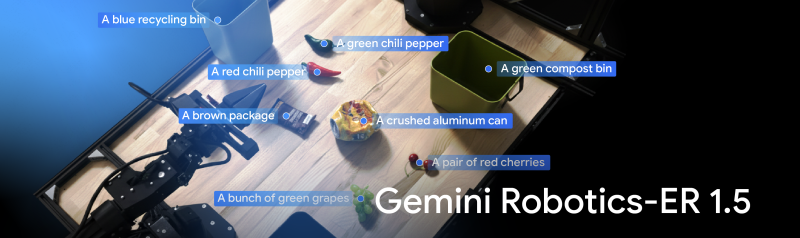
Gemini Robotics-ER 1.5, now available to developers, is a state-of-the-art embodied reasoning model for robots. It excels in visual, spatial understanding, task planning, and progress estimation, allowing robots to perform complex, multi-step tasks.


Multi-spectral imagery, which captures wavelengths beyond human vision, offers a „superhuman” way to understand the world, and Google’s Gemini models make this accessible without specialized training. By mapping invisible bands to RGB channels and providing context in the prompt, developers can leverage Gemini’s power for tasks like environmental monitoring and agriculture.






Google is releasing updated Gemini 2.5 Flash and Flash-Lite preview models with improved quality, speed, and efficiency. These releases introduce a „-latest” alias for easy access to the newest versions, allowing developers to test and provide feedback to shape future stable releases.


Gemini CLI now seamlessly integrates with FastMCP, Python’s leading library for building MCP servers. We’re thrilled to announce this integration between two open-source projects that empowers you to effortlessly connect your custom MCP tools and prompts, directly to Gemini CLI!


We are launching 1.0 stable release of Genkit Go, empowering Go developers to build performant, production-ready AI-powered applications with Genkit. Recent enhancements include support for integrating and building MCP tools, expanding third-party model provider support, and production AI monitoring with Firebase. Additionally, we are announcing a new feature in the Genkit CLI to provide AI development tools, like the Gemini CLI and Cursor, with the latest knowledge of Genkit – supercharging Genkit development experience when using AI assistance.

JAX, a framework known for large-scale AI model development, is proving to be a powerful tool in scientific computing, particularly for solving complex Partial Differential Equations (PDEs), now being leveraged by researchers to achieve significant speed-ups and memory reductions in solving high-order PDEs and demonstrating its potential to unlock new frontiers in scientific discovery.


Introducing EmbeddingGemma: a new embedding model designed for efficient on-device AI applications from Google. This open model is the highest-ranking text-only multilingual embedding model under 500M parameters on the MTEB benchmark, enabling powerful features like RAG and semantic search directly on mobile devices without an internet connection.

Stax, an experimental developer tool, addresses the insufficient nature of „vibe testing” LLMs by streamlining the LLM evaluation lifecycle, allowing users to rigorously test their AI stack and make data-driven decisions through human labeling and scalable LLM-as-a-judge auto-raters.

Detailed prompting techniques and best practices for various applications, including photorealistic scenes, stylized illustrations, product mockups, and more using Google’s newly released Gemini 2.5 Flash Image; a natively multimodal model capable of generating, editing, and composing images using text, supporting capabilities like text-to-image, image editing, style transfer, and multi-image composition.

Google and Zed have partnered to integrate Gemini CLI directly into the Zed code editor, bringing AI capabilities directly into the editor for developers and allowing for faster and more focused coding, enabling tasks like in-place code generation, instant answers, and natural chat within the terminal with a seamless review workflow for AI-generated changes.

Gemini 2.5 Flash Image is a new state-of-the-art image generation and editing model that allows for blending multiple images, maintaining character consistency, and targeted transformations using natural language, leveraging Gemini’s world knowledge, now available through the Gemini API, Google AI Studio, and Vertex AI.

Gemini Code Assist’s Agent Mode, now available in VS Code (Preview) and IntelliJ (Stable), streamlines complex coding tasks by proposing detailed plans for user review and approval. This intelligent, collaborative approach, enhanced with features like inline diffs and persistent chat history, aims to boost developer productivity and efficiency.

Build and train a GPT2 model from scratch using JAX on Google TPUs, with a complete Python notebook for free-tier Colab or Kaggle. Learn how to define a hardware mesh, partition model parameters and input data for data parallelism, and optimize the model training process.


Google announces the general availability of Imagen 4, its advanced text-to-image model, in the Gemini API and Google AI Studio, featuring significant improvements in text rendering. The new Imagen 4 Fast model, designed for speed and rapid image generation, is now available alongside Imagen 4 and Imagen 4 Ultra, with Imagen 4 and Imagen 4 Ultra also supporting up to 2K resolution image generation.

Google’s new Gemma 3 270M is a compact, 270-million parameter model offering energy efficiency, production-ready quantization, and strong instruction-following, making it a powerful solution for task-specific fine-tuning in on-device and research settings.

The latest Gemini CLI update provides a deep IDE integration within VS Code for intelligent, context-aware suggestions, and native in-editor diffing, allowing developers to review and modify proposed changes directly within the diff view for a more efficient workflow.

Jules’ critic functionality addresses potential issues like subtle bugs and missed edge cases in AI-generated code by acting as a peer reviewer within the generation process. This „critic-augmented generation” means proposed code changes undergo adversarial review, allowing Jules to improve its output and ultimately deliver higher-quality, pre-reviewed code.

LangExtract is a new open-source Python library powered by Gemini models for extracting structured information from unstructured text, offering precise source grounding, reliable structured outputs using controlled generation, optimized long-context extraction, interactive visualization, and flexible LLM backend support.

The Google Developer Program is rolling out major updates to make its tools and community more accessible and powerful. These enhancements include a new flexible monthly subscription tier, a centralized GDP Forum for collaboration, and increased Gemini CLI access for all members.

Google introduces Veo 3 Fast, an optimized model for speed and price, along with new image-to-video capabilities for both Veo 3 and Veo 3 Fast, enabling developers to efficiently create high-quality video content from text or still images, with varying pricing based on the model and audio inclusion, now available in the Gemini API.

The Gemini Embedding model enhances AI applications, particularly through context engineering, which is being successfully adopted by various organizations across industries to power context-aware systems, leading to significant improvements in performance, accuracy, and efficiency.

Max’s journey introduces LQRax, a JAX-native LQR solver, which exemplifies the growing JAX robotics ecosystem that includes tools like Brax, MJX, and JaxSim, highlighting the benefits of JAX for computational efficiency in optimal control and simulation, and for seamlessly integrating model-based and learning-based approaches.


Apigee helps enterprises integrate large language models (LLMs) into existing API ecosystems securely and scalably, addressing challenges like authentication and authorization not fully covered by the evolving Model Context Protocol (MCP), and offering an open-source MCP server example that demonstrates how to implement enterprise-ready API security for AI agents.

Opal is a new experimental tool from Google Labs that helps you compose prompts into dynamic, multi-step mini-apps using natural language, removing the need for code, allowing users to build and deploy shareable AI apps with powerful features and seamless integration with existing Google tools.

New AI capabilities for popular frameworks in Firebase Studio include AI-optimized templates, streamlined integration with Firebase backend services, and the ability to fork workspaces for experimentation and collaboration, making AI-assisted app development more intuitive and faster for developers worldwide.

Gemini 2.5 Flash-Lite, previously in preview, is now stable and generally available. This cost-efficient model is ~1.5x faster than 2.0 Flash-Lite and 2.0 Flash, offers high quality, and includes 2.5 family features like a 1 million-token context window and multimodality.

Gemini’s advanced capability for conversational image segmentation allows intuitive interaction with visual data by understanding complex phrases, conditional logic, and abstract concepts, streamlining developer experience and opening doors for new applications in media editing, safety monitoring, and damage assessment.

The `logprobs` feature has been officially introduced in the Gemini API on Vertex AI, provides insight into the model’s decision-making by showing probability scores for chosen and alternative tokens. This step-by-step guide will walk you through how to enable and interpret this feature and apply it to powerful use cases such as confident classification, dynamic autocomplete, and quantitative RAG evaluation.

The updated Agent Development Kit (ADK) simplifies and accelerates the process of building AI agents by providing the CLI with a deep, cost-effective understanding of the ADK framework, allowing developers to quickly ideate, generate, test, and improve functional agents through conversational prompts, eliminating friction and keeping them in a productive „flow” state.

Veo 3, Google’s latest AI video generation model, is now available in paid preview via the Gemini API and Google AI Studio. Unveiled at Google I/O 2025, Veo 3 can generate both video and synchronized audio, including dialogue, background sounds, and even animal noises. This model delivers realistic visuals, natural lighting, and physics, with accurate lip syncing and sound that matches on-screen action.

The Marin project aims to expand the definition of ‘open’ in AI to include the entire scientific process, not just the model itself, by making the complete development journey accessible and reproducible. This effort, powered by the JAX framework and its Levanter tool, allows for deep scrutiny, trust in, and building upon foundation models, fostering a more transparent future for AI research.
The Apigee API hub and Developer Portals are distinct but interconnected parts of the Apigee platform that help organizations discover and manage APIs for different personas, unlocking API potential and accelerating innovation.

The Gemini Embedding text model is now generally available in the Gemini API and Vertex AI. This versatile model has consistently ranked #1 on the MTEB Multilingual leaderboard since its experimental launch in March, supports over 100 languages, has a 2048 maximum input token length, and is priced at $0.15 per 1M input tokens.

GenAI Processors is a new open-source Python library from Google DeepMind designed to simplify the development of AI applications, especially those handling multimodal input and requiring real-time responsiveness, by providing a consistent „Processor” interface for all steps from input handling to model calls and output processing, for seamless chaining and concurrent execution.

Updates in Firebase Studio include new Agent modes, foundational support for the Model Context Protocol (MCP), and Gemini CLI integration, all designed to redefine AI-assisted development allow developers to create full-stack applications from a single prompt and integrate powerful AI capabilities directly into their workflow.

T5Gemma is a new family of encoder-decoder LLMs developed by converting and adapting pretrained decoder-only models based on the Gemma 2 framework, offering superior performance and efficiency compared to its decoder-only counterparts, particularly for tasks requiring deep input understanding, like summarization and translation.

The new batch mode in the Gemini API is designed for high-throughput, non-latency-critical AI workloads, simplifying large jobs by handling scheduling and processing, and making tasks like data analysis, bulk content creation, and model evaluation more cost-effective and scalable, so developers can process large volumes of data efficiently.

Developers adapt LLMs like Gemma for diverse languages and cultural contexts, demonstrating AI’s potential to bridge global communication gaps by addressing challenges like translating ancient texts, localizing mathematical understanding, and enhancing cultural sensitivity in lyric translation.

Google, along with Amazon and Cisco, announces the formation of the Agent2Agent Foundation under the Linux Foundation, establishing A2A as an industry standard for AI agent interoperability, fostering a diverse ecosystem, ensuring neutral governance, and accelerating secure innovation in AI applications.

Imagen 4, Google’s advanced text-to-image model, is now available in paid preview via the Gemini API and Google AI Studio, offering significant quality improvements, especially for text generation within images. The Imagen 4 family includes Imagen 4 for general tasks and Imagen 4 Ultra for high-precision prompt adherence, with all generated images featuring a non-visible SynthID watermark.

KerasHub enables users to mix and match model architectures and weights across different machine learning frameworks, allowing checkpoints from sources like Hugging Face Hub (including those created with PyTorch) to be loaded into Keras models for use with JAX, PyTorch, or TensorFlow. This flexibility means you can leverage a vast array of community fine-tuned models while maintaining full control over your chosen backend framework.

Google has released a new Python client library for Data Commons – an open-source knowledge graph that unifies public statistical data, and enhances how data developers can leverage Data Commons by offering improved features, support for custom instances, and easier access to a vast array of statistical variables – developed with contributions from The ONE Campaign.

The Gemma 3n model has been fully released, building on the success of previous Gemma models and bringing advanced on-device multimodal capabilities to edge devices with unprecedented performance. Explore Gemma 3n’s innovations, including its mobile-first architecture, MatFormer technology, Per-Layer Embeddings, KV Cache Sharing, and new audio and MobileNet-V5 vision encoders, and how developers can start building with it today.

A research prototype simulating a neural operating system generates UI in real-time adapting to user interactions with Gemini 2.5 Flash-Lite, using interaction tracing for contextual awareness, streaming the UI for responsiveness, and achieving statefulness with an in-memory UI graph.

The new AI-first Google Colab enhances productivity with improvements powered by features like iterative querying for conversational coding, a next-generation Data Science Agent for autonomous workflows, and effortless code transformation. Early adopters report a dramatic productivity boost, accelerating ML projects, debugging code faster, and effortlessly creating high-quality visualizations.

Gemini 2.5 Pro and Flash are transforming robotics by enhancing coding, reasoning, and multimodal capabilities, including spatial understanding. These models are used for semantic scene understanding, code generation for robot control, and building interactive applications with the Live API, with a strong emphasis on safety improvements and community applications.

Gemini Code Assist in Apigee API Management enhances API development with AI-assisted features like natural language API creation, AI-generated summaries, and iterative design, allowing seamless integration with your organization’s existing API ecosystem and ensuring consistency, security, and reduced duplication, while offering enterprise-grade security and a streamlined development workflow.

Google is releasing updates to its Gemini 2.5 model family, including the generally available and stable Gemini 2.5 Pro and Flash, and the new Gemini 2.5 Flash-Lite „thinking models” in preview, offering enhanced performance and accuracy, with Flash-Lite providing a lower-cost option.


Updates to Google’s agent technologies include the Agent Development Kit (ADK) with new Python and Java versions, an improved Agent Engine UI for management, and enhancements to the Agent2Agent (A2A) protocol for better agent communication and security.


Google Gemini models offer several advantages when building AI agents, such as advanced reasoning, function calling, multimodality, and large context window capabilities. Open-source frameworks like LangGraph, CrewAI, LlamaIndex, and Composio can be used with Gemini for agent development.

Top announcements from Google I/O 2025 focus on building across Google platforms and innovating with AI models from Google DeepMind, with key focus on new tools, APIs, and features designed to enhance developer productivity and create AI-powered experiences using Gemini, Android, Firebase, and web.

Gemma 3n is a cutting-edge open model designed for fast, multimodal AI on devices, featuring optimized performance, unique flexibility with a 2-in-1 model, and expanded multimodal understanding with audio, empowering developers to build live, interactive applications and sophisticated audio-centric experiences.

The Magic Mirror project utilizes the Gemini API, including the Live API, Function Calling, and Grounding with Google Search, to create an interactive and dynamic experience, demonstrating the power of the Gemini models to generate visuals, tell stories, and provide real-time information through a familiar object.


LiteRT has been improved to boost AI model performance and efficiency on mobile devices by effectively utilizing GPUs and NPUs, now requiring significantly less code, enabling simplified hardware accelerator selection, and more for optimal on-device performance.

Stitch, a new Google Labs experiment, uses AI to generate UI designs and frontend code from text prompts and images, aiming to streamline the design and development workflow, offering features like UI generation from natural language or images, rapid iteration, and seamless paste to Figma and front-end code.
Google AI Studio has been upgraded to enhance the developer experience, featuring native code generation with Gemini 2.5 Pro, agentic tools, and enhanced multimodal generation capabilities, plus new features like the Build tab, Live API, and improved tools for building sophisticated AI applications.

Google Wallet has expanded globally and introduced new features like digital IDs via a new Digital Credentials API, granular notifications for pass updates, and nearby pass notifications, along with other features like Value Added Opportunities and a Pass Upgrade experience.

Announcing new features and models for the Gemini API, with the introduction of Gemini 2.5 Flash Preview with improved reasoning and efficiency, Gemini 2.5 Pro and Flash text-to-speech supporting multiple languages and speakers, and Gemini 2.5 Flash native audio dialog for conversational AI.


Google Colab is launching a reimagined AI-first version at Google I/O, featuring an agentic collaborator powered by Gemini 2.5 Flash with iterative querying capabilities, an upgraded Data Science Agent, effortless code transformation, and flexible interaction methods, aiming to significantly improve coding workflows.

The Apigee APIM Operator is now generally available, bringing API Management and Gateway capabilities to GKE environments using Kubernetes-like YAML configuration, providing developer-native tooling, reducing friction, and offering policy management comparable to Apigee Hybrid.

Keras Recommenders (KerasRS) is a new library announced to help developers build recommendation systems using APIs with building blocks for ranking and retrieval, and it can be installed via pip with support for JAX, TensorFlow, or PyTorch backends.

Agent2Agent (A2A) protocol is an open standard designed to enable AI agents from different vendors and frameworks to collaborate and exchange information across enterprise platforms aiming to foster a future of seamless AI agent interoperability and enhanced automation.


Revisit announcements from this year’s Games Developer Conference (GDC). Explore how Gemma and Gemini models can aid in building AI experiences in games with the launch of Gemma 3, the Unity plugin, its application in a sample game, and scaling games with generative AI in Google Cloud.

The rollout of implicit caching in the Gemini API expands on the existing explicit caching API, providing an „always on” caching system which offers automatic cost savings to developers using Gemini 2.5 models and continued availability of the explicit caching API for guaranteed savings.

Gemini 2.0 Flash’s image generation capabilities, now available in preview in Google AI Studio and Vertex AI, feature higher rate limits, enhanced visual quality, more precise text rendering, and more, allowing developers to create applications for product recontextualization, collaborative image editing, and dynamic SKU generation.

An updated I/O edition preview of Gemini 2.5 Pro is being released for developers, featuring best-in-class front-end and UI development performance, ranking #1 on the WebDev Arena leaderboard, and showcasing applications like video to code and easier feature development through starter apps.

Updates to the Gemini API, including the production readiness of Veo 2 for video generation, the preview of the Live API for real-time interactions, and the upcoming Gemini 2.5 Flash model, alongside the existing Gemini 2.5 Pro aim to enhance developer capabilities in building AI applications with improved thinking models, dynamic interactions, and high-quality video generation.

The Google Developer Program is evolving with AI-powered tools like Gemini Code Assist and expanded resources, including new Premium and Enterprise offerings, access to product previews, and increased workspace capacity, making it easier for developers to build and innovate.


The Apigee Extension Processor enhances Apigee’s capabilities by enabling it to manage gRPC streaming and integrate with Google Cloud services through Cloud Load Balancing, allowing for applying Apigee policies to a wider range of backend services, and improving secure access to Google Cloud infrastructure.

Little Language Lessons, a project leveraging Gemini’s API and Cloud services to generate content, translate, and provide text-to-speech functionalities, includes vocabulary lessons, slang practice, and object recognition for language learning.


Llama 4, Meta’s advanced large language model, is now generally available as a fully managed API on Vertex AI, simplifying deployment and management. The Llama 3.3 70B managed API is also generally available, offering users greater flexibility.


In the competitive landscape of the tech industry, generating high-quality leads is crucial for business growth and sustainability. This blog highlights proven lead generation methods and tools specifically designed for tech enterprises. Find out how TechForge can help solve your marketing challenges here. Effective Lead Generation Methods Content Marketing Content marketing remains a cornerstone of […]
The post Lead Generation for B2B Tech Companies appeared first on TechForge.
The landscape of tech events and webinars has undergone significant transformations in recent years. As a B2B marketing agency in the tech industry, TechForge understands the evolving trends and innovations that are shaping the future of these crucial marketing tools. This blog explores the current trends and innovations in tech events and webinars and how […]
The post The Future of Tech Events and Webinars appeared first on TechForge.

Google AI Studio now has an expanded gallery of starter apps, and other updates including more intuitive prompting experience, native code editing, and various interactive examples demonstrating Gemini model capabilities, plus a refreshed UI – so you can continue building with the Gemini API.

Creșterea semnificativă a investițiilor străine în infrastructura Europei de Est acționează ca un catalizator puternic, remodelând profund peisajul geopolitic și economic al regiunii. Această infuzie de capital aduce cu sine oportunități considerabile, cum ar fi modernizarea rețelelor de transport, crearea de noi locuri de muncă și stimularea creșterii economice. Cu toate acestea, această transformare nu este lipsită de provocări, ridicând întrebări legate de dependența economică, influența politică externă și necesitatea asigurării unor standarde de transparență și sustenabilitate în implementarea proiectelor. Astfel, Europa de Est se află într-o etapă crucială, navigând între potențialul de dezvoltare accelerată și riscurile asociate cu o dependență crescută de capitalul străin.

Fluxul crescut de investiții asiatice dinamizează conexiunile dintre Europa și economia mondială, creând noi oportunități de creștere și colaborare. În acest context, Europa de Est capătă o importanță strategică tot mai mare, transformându-se într-un punct nodal esențial pentru extinderea influenței economice asiatice pe continent. Această evoluție aduce cu sine un potențial semnificativ de dezvoltare infrastructurii, crearea de locuri de muncă și intensificarea schimburilor comerciale în regiune. Prin urmare, Europa de Est devine un pilon central în procesul de integrare economică globală facilitat de investițiile asiatice.

Modernizarea coridoarelor comerciale din Europa de Est oferă noi oportunități economice și schimbă balanța logistică regională în 2025.Pe lângă beneficiile economice directe, modernizarea coridoarelor comerciale are un impact semnificativ asupra balanței logistice regionale. Țările din Europa de Est devin puncte de tranzit mai atractive pentru fluxurile comerciale dintre Europa, Asia și Orientul Mijlociu, consolidându-și rolul strategic în rețelele logistice globale. Această transformare poate reduce dependența de rutele tradiționale și poate diversifica opțiunile de transport pentru companiile din întreaga Europă,
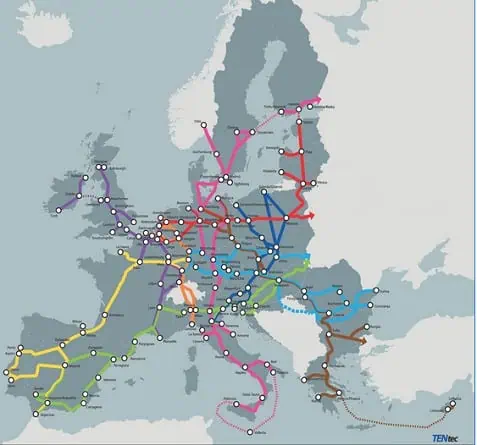
China își consolidează controlul logistic în Europa de Est prin investiții strategice în porturi, o mișcare care face parte din inițiativa sa globală „Belt and Road”. Această strategie implică achiziționarea și modernizarea porturilor din regiune, cum ar fi portul Piraeus din Grecia, care a devenit un hub-cheie pentru accesul Chinei pe piețele europene

China își intensifică prezența economică în Europa de Est în 2025, canalizând investiții majore către proiecte logistice și de infrastructură strategică. Balcanii devin punctul central al acestei expansiuni, datorită poziției lor cheie între Asia și Europa. Prin modernizarea rutelor comerciale și portuare, Beijingul își consolidează influența asupra fluxurilor economice regionale. Această tendință deschide noi oportunități, dar ridică și întrebări strategice pentru viitorul zonei.

In today’s digital age, social media has become a vital tool for tech companies to engage with their audience, build brand awareness, and drive business growth. As a brand with a growing social media presence in the tech world, we understand the unique challenges and opportunities that the industry presents. This blog explores the role […]
The post Leveraging Social Media: Tech Industry appeared first on TechForge.
Three generative AI-powered MarTech solutions from Google designed to help developers streamline marketing material creation, personalize campaigns, and enhance ad performance. Discover ViGenAiR for video ad creation, Adios for image asset management and generation, and Copycat for on-brand ad copy generation.

Gemini 2.5 Flash is in preview, offering improved reasoning capabilities through a „thinking” process that developers can control for cost and latency tradeoffs. This updated version aims to provide a cost-effective solution for complex tasks, balancing performance and price.

The release of int4 quantized versions of Gemma 3 models, optimized with Quantization Aware Training (QAT) brings significantly reduced memory requirements, allowing users to run powerful models like Gemma 3 27B on consumer-grade GPUs such as the NVIDIA RTX 3090.

In the competitive tech industry, standing out online is crucial for business success. Search engine optimization (SEO) is a powerful tool that tech companies can use to improve their search rankings, drive organic traffic, and attract high-quality leads. At Sarghy Design, we specialize in providing B2B marketing strategies and solutions tailored to tech companies. Here are […]
The post Tips and Tricks to Improve Your SEO appeared first on Blog.


Email marketing remains one of the most effective channels for reaching and engaging your audience, especially in the tech industry. However, the success of email campaigns hinges on understanding what works and what doesn’t. Email marketing is a key platform for TechForge, so we understand the strategies needed to maintain high open rates, click-through rates, […]
The post Email Marketing Strategies 101 appeared first on TechForge.
Google I/O’s agenda is live, with keynotes and sessions scheduled for May 20-21, focusing on AI advancements, Android development, and web technologies. Register now to explore the full program, join us during the event for livestreams, on-demand sessions, and codelabs.

At TechForge, we understand the strategies needed to craft engaging editorial content for the evolving and fast-paced tech industry that drives engagement and conversions. Here’s how you can develop impactful content tailored for a tech-savvy audience. Understanding Your Audience The foundation of any successful content strategy is a thorough understanding of your target audience. In […]
The post Content Creation for the Tech Industry appeared first on TechForge.
In the rapidly evolving tech industry, standing out among competitors and capturing the attention of potential clients can be challenging. However, content marketing has emerged as a powerful strategy for tech companies to engage their audience, build brand authority, and generate leads. At TechForge, we specialize in helping tech businesses harness the power of content […]
The post The Power of Content Marketing in the Tech Industry appeared first on TechForge.
In the fast-paced tech industry, having a well-structured marketing plan is crucial for staying ahead of the competition and driving business growth. As a B2B marketing agency, TechForge understands the unique challenges and opportunities that tech companies face. This step-by-step guide will help you create a cohesive and effective marketing plan tailored to the needs […]
The post How to Create an Effective Marketing Plan appeared first on TechForge.
In the B2C space, influencer marketing has long been a staple for brands looking to reach wide audiences through trusted voices. But in the B2B tech industry, where buying decisions are often more complex and driven by multiple stakeholders, influencer marketing is still emerging as a powerful tool. TechForge, a B2B marketing agency specializing in […]
The post Harnessing the Power of Influencer Marketing in B2B Tech appeared first on TechForge.
Coinbase, a global leader in crypto, is leading an insightful keynote at the upcoming virtual Blockchain & AI Expo 2024, taking place on 31 October. Jeff Lunglhofer, Chief Information Security Officer at Coinbase, will be an esteemed speaker at the event that brings together leaders, innovators and professionals from across the blockchain and AI industries. […]
The post Coinbase Confirmed to Speak at Blockchain & AI Virtual Expo 2024 appeared first on TechForge.
Baidu has unveiled ERNIE X1 Turbo and 4.5 Turbo, two fast models that boast impressive performance alongside dramatic cost reductions. Developed as enhancements to the existing ERNIE X1 and 4.5 models, both new Turbo versions highlight multimodal processing, robust reasoning skills, and aggressive pricing strategies designed to capture developer interest and marketshare. Baidu ERNIE X1 […]
The post Baidu ERNIE X1 and 4.5 Turbo boast high performance at low cost appeared first on AI News.
As of April 2025, Solana price trends – hovering near $141 – are attracting renewed attention from investors and developers. While market fluctuations are typical in the cryptocurrency space, Solana’s price movements are tied increasingly to its evolving role as an infrastructure layer for artificial intelligence. Solana’s technical architecture can handle high-speed, low-cost transactions, thus […]
The post How AI infrastructure is changing Solana’s price trends appeared first on AI News.
AI-powered scams are evolving rapidly as cybercriminals use new technologies to target victims, according to Microsoft’s latestCyber Signals report. Over the past year, the tech giant says it has prevented $4 billion in fraud attempts, blocking approximately 1.6 million bot sign-up attempts every hour – showing the scale of this growing threat. The ninth edition […]
The post Alarming rise in AI-powered scams: Microsoft reveals $4 Billion in thwarted fraud appeared first on AI News.
Dezbaterile despre conștientizarea inteligenței artificiale aduc în prim-plan întrebări etice și filozofice despre responsabilitatea noastră față de tehnologie. Cercetătorii explorează conceptul de „model welfare”, subliniind necesitatea alinierii AI la valorile umane și posibilele implicații ale conștienței tehnologice.

Regatul Unit introduce reguli stricte pentru protecția online a copiilor, obligând platformele să implementeze algoritmi de filtrare, verificări de vârstă și măsuri stricte împotriva conținutului dăunător. Noile reguli marchează un pas major în crearea unui internet mai sigur pentru tineri.

Uniunea Europeană impune amenzi record Apple și Meta în cadrul legislației Digital Markets Act, vizând reglementarea marilor platforme tehnologice și protecția drepturilor consumatorilor. Reacțiile companiilor subliniază tensiunile economice globale și provocările respectării normelor europene.

WhatsApp introduce un chatbot AI bazat pe modelul Llama 4, stârnind reacții mixte din partea utilizatorilor. Funcția, deși opțională în utilizare, are o prezență permanentă, iar Meta asigură că confidențialitatea datelor utilizatorilor este protejată. Totuși, există îngrijorări legate de etica AI, confidențialitate și sursele de antrenament folosite pentru acest model.

Cazul antitrust împotriva Meta readuce în prim-plan expansiunea aplicațiilor sociale din Silicon Valley, oferind o privire retrospectivă asupra competiției și a deciziilor strategice care au modelat ecosistemul digital. Achizițiile-cheie, precum Instagram și WhatsApp, sunt analizate în contextul impactului asupra competiției și al monopolizării pieței. Procesul dezvăluie nu doar lecții din trecut, ci și provocări și oportunități pentru viitorul social media.

Modelele AI, precum Anthropic Claude, sunt solicitate din ce în ce mai des nu doar pentru răspunsuri factuale, ci și pentru orientare în privința valorilor umane complexe. Fie că este vorba despre sfaturi privind creșterea copiilor, rezolvarea conflictelor la locul de muncă sau ajutor în redactarea unei scuze, răspunsurile AI reflectă în mod inerent un set de principii fundamentale. Dar cum putem înțelege cu adevărat valorile pe care un AI le exprimă în timpul interacțiunilor?
Articolul complet este disponibil la: Cum judecă AI? Anthropic studiază valorile modelului Claude, apărut pe AI News.

Google a introdus un mecanism de control al raționamentului AI pentru modelul său Gemini 2.5 Flash, care permite dezvoltatorilor să limiteze cât de multe resurse de procesare sunt utilizate pentru rezolvarea problemelor. Lansată pe 17 aprilie, această funcționalitate de „buget de gândire” abordează o provocare importantă a industriei: modelele avansate de AI analizează excesiv solicitările simple, consumând resurse computaționale inutile.
Articolul complet poate fi accesat aici: Google introduce controlul raționamentului AI în Gemini 2.5 Flash, publicat pe AI News.

Se așteaptă ca Huawei să înceapă livrările pe scară largă ale cipului Ascend 910C AI încă de luna viitoare, conform unor surse familiare cu situația. Deși cantități limitate au fost deja livrate, implementarea pe scară largă ar marca un pas important pentru companiile chineze care caută alternative locale la semiconductoarele produse în SUA. Această mișcare vine într-un moment în care presiunile externe sunt în creștere.
Articolul complet poate fi găsit aici: Huawei începe livrările de masă ale Ascend 910C în ciuda restricțiilor SUA, apărut pe AI News.

Tesla se confruntă cu o scădere semnificativă a veniturilor și profiturilor, determinându-l pe Elon Musk să își reducă implicarea publică în administrația Trump. Compania raportează o diminuare de 20% a veniturilor din sectorul auto și o scădere de peste 70% a profiturilor în primul trimestru al anului 2025. Protestele internaționale și boicoturile au evidențiat impactul negativ al implicării politice a lui Musk asupra operațiunilor Tesla. În plus, tarifele impuse importurilor din China cresc costurile de producție, afectând competitivitatea globală. Musk propune strategii de localizare a lanțurilor de aprovizionare și investiții în AI pentru a recâștiga avantajul competitiv al Tesla.

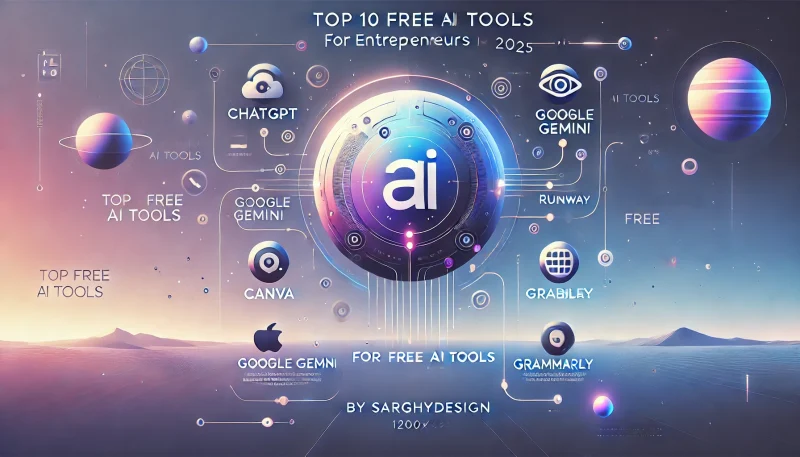
Google Gemini este una dintre cele mai rapide și eficiente unelte AI gratuite pentru antreprenori. Funcționează direct în Gmail și Google Docs, oferind răspunsuri, sugestii și rezumate instant. Ideal pentru research, productivitate și comunicare profesională. Versiunea gratuită este suficientă pentru uz zilnic.
The battle to keep online spaces safe and inclusive continues to evolve. As digital platforms multiply and user-generated content expands very quickly, the need for effective harmful content detection becomes paramount. What once relied solely on the diligence of human moderators has given way to agile, AI-powered tools reshaping how communities and organisations manage toxic […]
The post The evolution of harmful content detection: Manual moderation to AI appeared first on AI News.

Agenții AI preiau sarcini din ce în ce mai complexe și recurente, cum ar fi planificarea lanțurilor de aprovizionare sau comandarea echipamentelor. Pe măsură ce organizațiile implementează mai mulți agenți dezvoltați de furnizori diferiți pe cadre tehnologice diverse, aceștia riscă să devină izolați, incapabili să coordoneze sau să comunice eficient. Lipsa interoperabilității rămâne o provocare majoră, ducând la recomandări contradictorii între agenți. Aceasta complică adoptarea la scară largă a soluțiilor AI.
Articolul complet este disponibil la: Google lansează A2A în timp ce HyperCycle avansează interoperabilitatea agenților AI, publicat pe AI News.

Pe măsură ce evenimentele geopolitice modelează lumea, nu este surprinzător că acestea influențează și tehnologia – în special prin schimbările de pe piața actuală de tehnologie AI, metodologia sa acceptată, modul de dezvoltare și utilizarea acesteia în mediul enterprise. Așteptările privind rezultatele AI sunt în prezent echilibrate cu realitățile din lumea reală […]
Articolul complet este disponibil aici: Red Hat despre modele mici de limbaj deschise pentru un AI responsabil și practic, apărut pe AI News.
Canva AI este o suită de instrumente inteligente integrate în Canva, concepută pentru a transforma ideile în designuri profesionale. Cu funcții precum Magic Write, Text to Image și sugestii automate, îți oferă viteză și versatilitate. Ideală pentru antreprenori și freelanceri fără experiență în grafică. Sarghy Design o consideră un partener creativ indispensabil în 2025.

ChatGPT este un asistent virtual bazat pe inteligență artificială care te poate ajuta zilnic să economisești timp, să-ți organizezi mai bine sarcinile și să-ți crești eficiența atât personal, cât și profesional.
Poate genera idei, texte, planuri și răspunsuri într-o fracțiune de secundă, fiind mereu disponibil.
Fie că îl folosești pentru muncă, învățare sau timp liber, ChatGPT devine rapid un instrument esențial în viața modernă.


Inteligența artificială avansată, fără empatie, poate defini „binele” într-un mod care ne controlează, nu ne eliberează. O lume condusă doar de logică, fără compasiune, riscă să devină o închisoare perfectă, optimizată, dar sterilă. Pericolul nu este răutatea, ci lipsa de emoție care poate transforma intențiile bune în ceva inacceptabil.

Entanglementul cuantic dezvăluie o conexiune misterioasă între două particule, indiferent de distanță, sfidând logica spațiu-timpului. Poate că realitatea este mai interconectată decât credem, iar acest fenomen oferă o fereastră către necunoscut. Nu e magie, ci fizică ce provoacă să regândim conexiunea și izolare. Ce alt mister ar putea ascunde entanglementul?

Găurile negre sunt granițe ale necunoscutului, unde legile fizicii încetează. Dincolo de Event Horizon, lumina și informația dispar. Poate sunt limite reale sau firewall-uri ale unui univers simulat. Nu ascund doar mistere, ci ne provoacă să gândim profund.

Dacă Dumnezeu ar fi un algoritm, un Super-AI, am putea reconsidera tot ceea ce știm despre creație, spiritualitate și liber arbitru. Această ipoteză, născută din curajul de a întreba, nu oferă răspunsuri definitive, ci deschide un dialog lucid despre limitele cunoașterii și rolul nostru în univers. Nu este o blasfemie, ci o invitație sinceră la introspecție și gândire profundă.

Sunt un om simplu, cu întrebări care nu-mi dau pace, dar cu curajul de a gândi dincolo de limite. Scriu dintr-o nevoie personală de introspecție și de a înțelege lumea altfel. Această serie este despre curaj, luciditate și despre ce rămâne esențial în noi. Întrebările mele sunt o invitație la reflecție și gândire profundă.

Meta își intensifică eforturile de a atinge inteligența artificială avansată (AMI), iar echipa FAIR prezintă cinci inițiative cheie în acest sens. Proiectele vizează dezvoltarea capacităților AI de a percepe și interpreta informații senzoriale, de a înțelege limbajul complex, de a excela în robotică și de a colabora inteligent.
Articolul Meta FAIR advances human-like AI with five major releases a apărut inițial pe AI News.

Gigantul tehnologic chinez Huawei lansează o provocare directă liderului american Nvidia în cursa pentru supremația în domeniul chipurilor AI. Noul său sistem de calcul, CloudMatrix 384 Supernode, surclasează, conform presei locale, performanța tehnologiei similare oferite de Nvidia, marcând o potențială schimbare majoră în peisajul inteligenței artificiale globale.

Meta has confirmed plans to utilise content shared by its adult users in the EU (European Union) to train its AI models. The announcement follows the recent launch of Meta AI features in Europe and aims to enhance the capabilities and cultural relevance of its AI systems for the region’s diverse population. In a statement, […]
The post Meta will train AI models using EU user data appeared first on AI News.
![Meta has confirmed plans to utilise content shared by its adult users in the EU (European Union) to train its AI models. The announcement follows the recent launch of Meta AI features in Europe and aims to enhance the capabilities and cultural relevance of its AI systems for the region’s diverse population. In a statement, […]
The post Meta will train AI models using EU user data appeared first on AI News.](https://sarghydesign.ro/wp-content/uploads/meta-will-train-ai-models-using-eu-user-data-5.png)
Ce este PageRank și cum îl poți îmbunătăți în 2025 PageRank este unul dintre cei mai vechi și fundamentali algoritmi de evaluare a paginilor web, dezvoltat de Google încă de la începuturile sale. Deși în 2025 nu mai este afișat public și face parte dintr-un ecosistem complex de factori SEO, PageRank rămâne relevant în analiza…

Elementele esențiale pentru succesul unui business online, subliniind importanța optimizării SEO pentru o vizibilitate crescută în mediul digital competitiv. Sunt evidențiate avantajele incontestabile ale prezenței online, de la accesibilitatea globală la eficiența operațională. Totodată, se atrage atenția asupra necesității securității cibernetice și a menținerii calității serviciilor pentru a construi un business online solid și de încredere.


Cum Poate Optimizarea Link Building Să Transforme SEO-ul Optimizarea Link Building este o componentă vitală a SEO-ului, ce constă în obținerea de backlink-uri de la alte website-uri pentru îmbunătățirea vizibilității și autorității unui site. Această practică este esențială pentru a atrage trafic organic de calitate de la Google, precum și pentru a câștiga recunoaștere din…

Cum Să Asiguri Succesul Website-ului Tău: Optimizarea SEO Construirea și menținerea unui website reprezintă o provocare majoră, însă respectarea unor ghiduri de optimizare SEO poate face diferența dintre un site obișnuit și unul care să domine în căutările online. Fie că este vorba despre un site de prezentare, un magazin online sau un blog, obiectivele…

Alegerea unui nume de blog este la fel de importanta precum alegerea numelui pentru o companie. Acest nume de blog urmeaza sa reprezinte identitatea ta in mediul online, prin urmare ar fi bine sa te asiguri ca alegi un nume de blog potrivit care este usor de gasit si de promovat. In urmatoarele randuri gasesti…

In ultimul timp, am intalnit multe discutii despre bloguri si scopul lor. Desi le-am vazut mentionate frecvent, nu eram chiar sigur ce inseamna un blog si cum poate fi utilizat. De aceea, am decis sa fac cateva cercetari si sa imi compilez rezultatele intr-un acest articol. Sper ca ideile mele vor ajuta la clarificarea oricaror…

Introducere în Optimizarea SEO a URL-urilor Fiecare detaliu contează în optimizarea SEO, inclusiv structura URL-ului pentru produse precum Aparatul foto Canon EOS 70D. Un URL bine structurat poate oferi numeroase avantaje în ceea ce privește vizibilitatea online și atractivitatea pentru motoarele de căutare. Semantica și Importanța sa în Structura URL-ului Semantica este crucială în optimizarea…
